Showing posts with label COSTUME DRAMAS. Show all posts
Showing posts with label COSTUME DRAMAS. Show all posts
Did you like HBO's Band of Brothers, but thought it could have been improved with the inclusion of real life brothers, not figurative brothers? Did you find Peter Weir's "Gallipoli" too short, and would appreciate the same narrative dragged out over a whole lavish miniseries? Gallipoli has been described in its lavish promotional advertisement as "Australia's Television Event of the Year", and it probably is. The makers also probably had a checklist of required elements needed to sell it to today's television audience. From the classy "True Detective" opening sequence, under equipped medical orderlies on the beach (medical dramas always a big hit with audiences longing to fill that House/Greys Anatomy void- both might still be on television), the best friend from "Bridget Jones Diary" as a journalist doing hard hitting investigative journalism just like Season Five of "The Wire"; the heavy handed treatment of Generals eating with silver cutlery and then jump cutting to soldiers dying in crudely dug foxholes; and also some hinted at, possibly later developed when the girl turns up as a Nurse which is what I am picking for this show, romantic circle with the two brothers and one hot 1915 Australian babe. All it is missing is a home renovation angle, although time may tell on this and as they start building trenches there are real possibilities for this to develop.
The cliched treatment of the conflict continues throughout the first episode I watched, admittedly it is hard not be cliched as the story has been told so many times. The greatest issue the story has so far is presenting a balanced view, however the need to express outrage at the folly of sending troops to the Dardenelles in the first place seems a bit redundant. I felt in its own way, the program did attempt to flesh out the Generals who initially seem brash and confident, but as the reality of the initial failure of the landings are revealed begin to challenge their own views. But it seems as if they used Australian actors to play the English, too busy in other costume dramas to be involved in Australia's Television Event of the Year". The program so far has a bit of a Turkish problem. Not confident enough to treat the Turks as equal partners in the conflict, they are reduced to stock characters who are cannon fodder. There seems no difference between their treatment in the first episode and what it would have been in a 1926 film version. While the Australians get back stories, flashbacks and dialogue, we are left to infer from the look of fear in the Turkish soldiers that they too are thinking of their halcyon days in Anatolia, sipping apricot wine and dancing.
The issue for ABC's "Gallipoli" however is not it's ambitions or even the racist undertones of treating the Turkish Army as second class citizens in its broader story of constructing an Australian identity out of the debacle.1 It is, instead, that it is not doing anything new with the format. The 70,000 strong Mediterranean Expeditionary Force, of which the Anzacs formed about 28.7% of the total force, landed at Gallipoli in 1915 in a big push to open up the Bosporus. This of course has been tackled in "Anzacs" , a 1985 four part miniseries, which covered mateship, larrikanship and the formation of the Australian Identity TM ; Peter Weir's feature length 1981 film "Gallipoli", covered the same material with an emphasis on the futility of the campaign, also featured scenes of Mel Gibson on a horse; "Çanakkale Yolun Sonu", a 2013 Turkish rendering of exactly the same story from the Turkish perspective except without the larrikanism and with bigger mustaches; "Gallipoli" a 2005 documentary that is considerably better than all of the previous documentaries and goes for a balanced view from both sides and Jeremy Irons; also "All the King's Men" a 1999 feature length TV movie, which covers the same territory except without ANZACS and all the formation of a national identity business.
Still, the production qualities of this new ANZAC program are A grade. Who knows if it will continue its passable grade. At the moment it is probably as good as HBO's The Pacific. Also, as all the main characters seemed to survive day one of the invasion- apart from the heroic Captain who was holding the ridge, serving to illustrate the horror of war, we can be sure that we are going to lose some key players probably by episode four. We can also be sure that highlights of upcoming episodes: the formation of the Australian national identity, meeting some Kiwi jokers, humanising the Ottoman Turks, some nude swims in the Bosphorus, and more shots of the Generals enjoying silver service onboard the state rooms of the Queen Elizabeth.
1. This is ignoring, of course, the way in which for Turkey, the First World War provided a massive impetus to foge a new identity as well. A secular and modern state which was, like Australia shaped by its experience of WW1. Of course, the Australians are meant to be forging their identity in opposition to the British, depicted as removed, calculating and wildly out of touch. Despite British troops also holding the line further down the Coast, which are apparently not part of the narrative in ABC's Gallipoli. Admittedly HBO's "Band of Brothers" tended to take a similar approach with its focus on Easy Company, and you do occasionally hear talk of the British holding the line in the first episode. But we don't get to see their reality.
ABC's Gallipoli
One would think that, judging on the reviews so far, that all I have watched this year have been period dramas. This is mostly correct. It has been a while since I have seen something that wasn't historical, although that latest Dardenne Bros film with Marion Cotillard was fantastic for me - not so great for Mom who fell asleep on the couch during it. See also "Force Majeure". Anyway, I have eluded to the "Wives and Daughters" program in earlier reviews and now, after watching the four episodes, I can make good on my promise of providing in depth coverage.
Wives and Daughters is about a Scottish doctor and his daughter. Her mother has passed away and they seem to be coping pretty well, she is friends with their neighbours who are asset rich, cash poor. They have two attractive sons, introduced as two distinctly different prospects. The poet and the scientist. We are set up for a love triangle and then it never eventuates. The daughter is a goer.
Every episode should have been whittled down to a half hour. The doctor gets married again to Nanny Doreen, which is probably the only reason to watch the programme. Oh and Michael Gambon is pretty good as the poet and scientist's father. But I am ignoring the real reason to enjoy the show is the main actress.


Wives and Daughters is about a Scottish doctor and his daughter. Her mother has passed away and they seem to be coping pretty well, she is friends with their neighbours who are asset rich, cash poor. They have two attractive sons, introduced as two distinctly different prospects. The poet and the scientist. We are set up for a love triangle and then it never eventuates. The daughter is a goer.
Every episode should have been whittled down to a half hour. The doctor gets married again to Nanny Doreen, which is probably the only reason to watch the programme. Oh and Michael Gambon is pretty good as the poet and scientist's father. But I am ignoring the real reason to enjoy the show is the main actress.

Mads asked me the other night in this weird night where I couldn't get to sleep, which is weird because I am basically clockwork at bed by 10.30pm, who my celebrity crush was. I don't really have any, not now I have the love of my life in my life all the time. But if I am honest to myself, it is this babe.
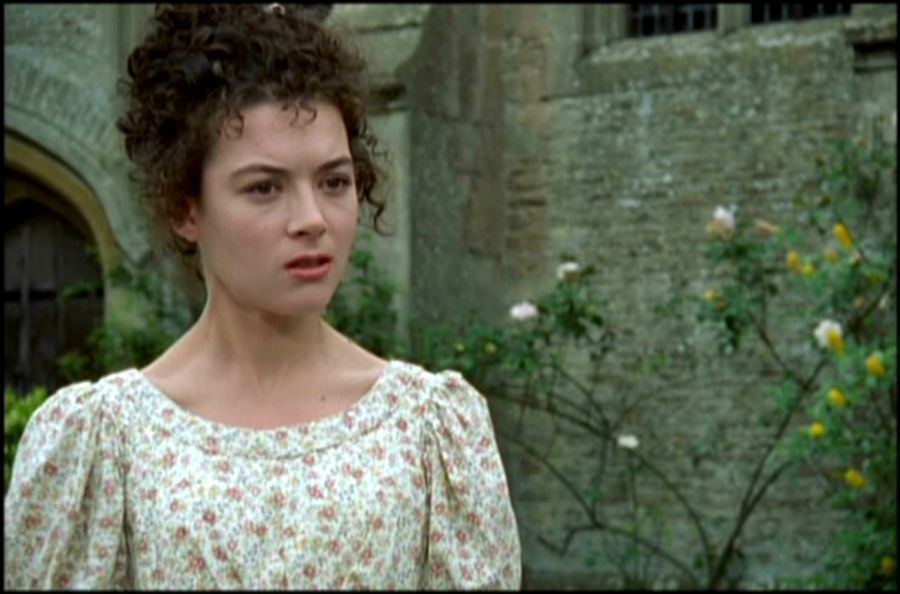
Here she is again, pouting.
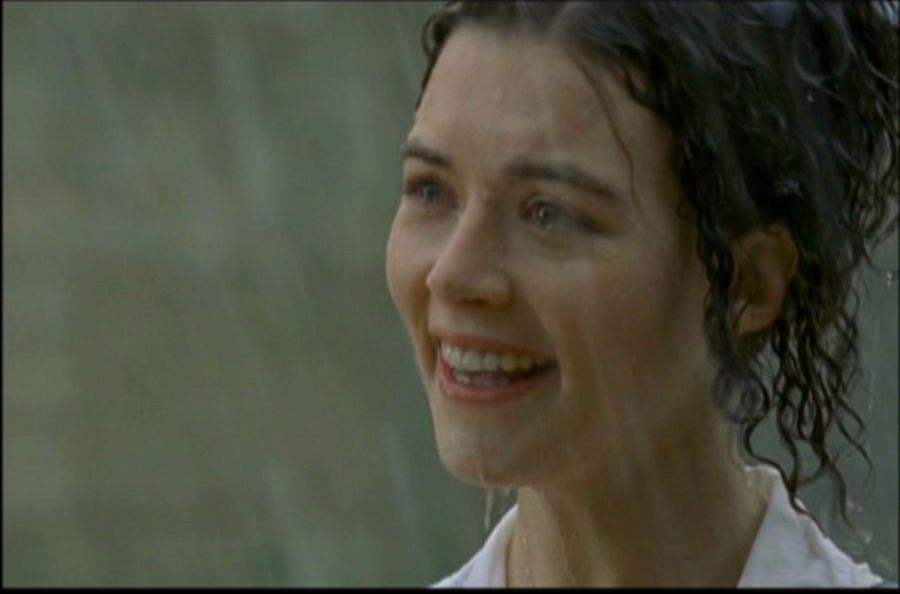
He she is, this time in the rain. The thing ends with her in the rain with the scientist brother. (Spoiler alert) Actually the thing ends with them in Africa, her in trousers. The show isn't afraid to blow the budget on taking two main characters to Africa.

Here she is again.
There is a whole heap of gossip that goes down, a range of balls and Rosumund Pike turns up. I guess it is okay, I felt like it was definitely the sort of thing we would have all loved, or at least Sophie, Mom and I would have really loved in about 2001. The actress who plays the female lead didn't have too much of a career after costume dramas, tried to make the tricky transition to Hollywood and has not made a movie since 2006, which was directed by Tarsem Singh who has never made a good movie. I blame Tarsem for ruining her career. She seriously lights up the screen in this show.
Wives and Daughters
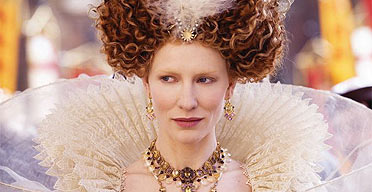 |
| Not included in the Golden Age of Costume Dramas. |
Continuing the Tudor costume drama theme "Elizabeth: The Golden Age" should have successfully filled in the gap between episodes of BBC's Wolf Hall. It should have also, having a budget of $50-60 million dollars, been a considerably more upscale production- both in its ambitions and mise-en-scène. Futhermore, in 2007 when Cate Blanchett reprised the role, she had not been in a "bad" film.

Not that "Elizabeth is a "bad" film, it is just not particularly good.
I feel I might also need to qualify that Cate Blanchett had been in "Babel", which I am confident is not as good if I watched it the second time and I am pretty sure has Brad Pitt as a sniper or something like that and he kills an Arabic child (he may have been a hunter) but I am very blank and Blanchett's role; Little Fish, which I am definitely iffy on; and the Good German, which despite being a costume drama and about WW2, or at least the immediate aftermath, I fell asleep in both times I have tried to watch it.
As Cate Blanchett made the original "Elizabeth" in 1998, the ten years that had passed between the two films produced an sequel that was over stuffed and fussed over every detail. Perhaps it wasn't the ten years, but something had happened to the director and writer between the two films. By 2008, a new co writer had been brought on to patch up the myriad plot lines. William Nicholson had helmed "First Knight", a terrible Sean Connery film, and co-written Gladiator.
The dense plotting that "Wolf Hall" achieves over the course of six episodes is crammed into the run time of "The Golden Age". Perhaps over the ten years, Michael Hirst had written a range of possible options, and Hollywood decided to ram them all into one endless succession of bewigged and beruffed actors quickly edited together to fit in the big Armada sequence at the end.
We have Elizabeth dealing with middle age, flirting with Clive Owen, getting unsuccessfully wooed by a range of suitors. Mary Queen of Scots in prison machinating with Catholics, Prince Philip whose insanity is underlined and highlighted every time he is in shot, the construction of the Spanish Armada; Catholic plotters, an assassination attempt; the impregnation of one of Elizabeth's chambermaids and finally, in one of the most anti climatic naval sequences since Hornblower (which at least had the defense of having no budget), the demise of the Spanish Armada.
This was definitely the low point, as it was confusingly edited and was a mess. Pretty sure the reason the English won initially was the fast moving smaller ships versus the Spanish slow moving galleons; also the massive storm that scuppered the Spanish proving that God was actually Protestant after all. "Elizabeth: The Golden Age" controversially posits the fireships being the real deal breaker because they I guess are easier to film than the complicated naval tactics of the English navy. Also has this fucking bullshit shot of Clive Owen clinging to the side of the fireboat before he leaps into the sea.
Everything seems to be moving at an unnecessarily brisk pace, like when Clive Owen puts his cloak down so Blanchett doesn't have to get her feet muddy. We don't see the mud, we have only the most cursory of glances between the characters and then Clive Owen is essential to the narrative. I guess I should be grateful, as the pace meant the film ended sooner than it should have. But it definitely savoured somewhat of an anti climax, especially in comparison with the first film. But then I haven't really watched the first film since about 1998, and it probably isn't actually that good.
The film's subtitle "The Golden Age" hints at the prosperity that lay within England's grasp, but it took the second Armada for Raleigh to really claim dominance over the Spanish. Elizabeth never really sorted out the Catholic problem in the film, or many of her problems- like creating an heir or sorting out the mechanisms of finance for England's beleaguered coffers and life seems pretty shit for most people in the Golden Age aside from Elizabeth's immediate circle. The price of food went up 75% during her reign, not that this film cared. The only thing it cared about was making Elizabeth look pretty in her big dresses, which it achieved.
Elizabeth: The Golden Age
Subscribe to:
Posts
(
Atom
)